Category: Self-publishing in Kenya

Topics on Self Publishing in Kenya

  • Copy Paste vs Authenticity – Did You Know Intellectual Property is Gaining Importance in Kenya?

    Copy Paste vs Authenticity – Did You Know Intellectual Property is Gaining Importance in Kenya?

    This post is going to explore the threat of plagiarism faced by most writers, bloggers, content creators, and others. Since the world is online, and content has become a means to earn, copy-paste is more prevalent than authenticity.

    I recently received a message from a reader about content that might have been copy-pasted from my blog and posted elsewhere. Since the information in question is in the public domain, I was not overly concerned.

    I am eternally grateful to the lady who found the content and was happy to message me about the suspected infringement. I think that is the best and more awesome thing to happen. I love all my readers, but she is amazing for telling me.

    Now, the truth is we all post content online with the knowledge that after a time, someone somewhere is going to find it interesting enough to copy-paste it. It happens. It is not okay, but it does. Instead of getting worried, scared, or angry. It is better to arm yourself with the tools to face this threat. Empower yourself with the means to protect your creative content.

    So, I have two stories to share with you.

    The first story is about an author who got their work plagiarized on a site called Inkitt by a second party. The plagiarism incident consisted of this second party taking the author’s work (novel), changing the title and the names of the characters, but keeping everything else similar down to the spelling and grammar. The second party got a couple of readers and comments complimenting them on the work. Of course, one of these readers happened to know the story belonged to someone else. And so, the author received a message on Instagram from a fan who wrote, ‘Someone tried to copy your book on inkitt’, included was the link to the copied work and the account of this second party.
    Now, after the initial shock, this author friend of mine started a search for what to do. The first and most direct thing she did was to contact inkitt.com and see if they can help.
    Inkitt.com wasted no time in dealing with the matter. They do not tolerate plagiarism, and the second party was penalized the moment the complaint was verified. The incident lasted less than twenty-four hours. The plagiarized story was taken down.

    In this story, the author learned about the case of plagiarism because of a fan. This is the first line of defense an author has and should cultivate. If your work is good and authentic, and it engages your readers, your readers will be the first people to tell you if your content is published elsewhere without your consent.

    Now, if it happens to you, and you find your creative content plagiarized online, you are empowered and there is no need to feel as though you can’t publish again.

    1. The first line of defense is to approach the site you found the content and make a simple request. Claim the work as yours, and ask that it be removed. A ‘cease and desist’ request. Five out of ten times, the person who has plagiarized will bring it down without reaching out to you and you won’t have to worry about it.
    2. If no response happens, discover the FAQs about the website. If the person who has plagiarized the work does not own the site. If the site is owned by an organization like Inkitt, you can reach out to the organization and ask them to pull the work down. They will do it if you can prove ownership of the work. If the site is owned privately, and the author has refused to respond, then move on to the third option.
    3. Search engines like Google offer tools like Content Removal if an incident of copyright infringement occurs. They slap a DCMA complaint on the site and the content is no longer crawled on the search engine. The burden of origination and verification is on the original author, but if you are confident and have the information needed, Google is quite efficient in removing copyright infringement articles and content. You will find the instructions on how to do this here. Bing also offers you the same tools. If you’re running a wordpress.com site, Automattic offers you the means to file a complaint of copyright infringement. This brings me to my second story.

    The second story is about a Kenyan-based business name owner and an international organization that registered the same name as a trademark. In November 2022, the international organization used Automattic to file a complaint of copyright infringement on their trademark against the Kenyan-based business name owner. The complaint was written as follows:

    A clear and detailed explanation of how the above content is in violation of the trademark in question, thus creating consumer confusion: We are contacting you on behalf of the French company “xxxxx”, whose head office is “xxxx, PARIS”.
    We have noticed (see below) that you are using the mark "XXXXXX” without the consent of the owner of the trademark and are therefore violating their intellectual property rights.
    By this letter, we request that you cease all disputed use of the trademark and/or take all appropriate measures to ensure that the infringing uses are removed.
    I have a good faith belief that use of the trademark as described above is an infringement of the rights granted under United States and/or foreign trademark law.: Yes
    I understand that a copy of this notice, including any contact information I provided above, will be forwarded to the blog owner.: Yes
    Signed on this date of (today's date, MM/DD/YYYY): 10/11/2022
    Signature (your digital signature is legally binding): XXXXX
    

    Obviously, the Kenyan-based business name owner started a frantic search for how to handle this complaint. Why was dealing with this complaint so important?

    1. The blog in question is over ten years old, with great traffic, and an enormous amount of content.
    2. The business name represented a physical business in Nairobi, Kenya.
    3. Kenya has signed these treaties that help international companies protect their copyright.

    At first glance, there is the thought that this person making the complaint is located in another country, France to be exact, which is on another continent. How could they present this big a problem to a business in Kenya?

    A second glance brought out all the weaknesses. The business name owner in Kenya may have started out not intending to infringe on the France-based organization. However, as time continued, the blog grew, and the physical business grew, it drew more attention. The legal standing of the business name owner in Kenya came into question.

    Now, if the business name is not registered with the company’s registrar or trademark office in Kenya, they have no legal standing to fight the complaint. At the time of this complaint, they had no legal right to fight the complaint.

    So, the right answer was to comply with the complaint. The blog is also under Automattic’s jurisdiction. If Automattic wanted to stop hosting the blog, then they would, of course after a conversation with both parties.

    After painful deliberations, the Kenyan-based business name owner decided to approach KIPI with a different variation of their business name and complete the necessary registrations in order to stop this from happening again.

    The reason I tell you this story now is that it is 2023 and our dear country has grown up. Intellectual Property is becoming more important. There are more court cases settling matters of trademark infringement, copyright infringement, and copyrights. The copyright office is making a larger effort to document and offer authors, creators, companies, musicians, artists, and artisans the means to claim their copyrights.

    In this same case, it is getting easier for international companies to log copyright infringement cases against Kenyans.

    Why? We start our websites on wordpress.com, make content for Youtube, and want to crawl our sites on Google. These sites have to comply with various copyright laws, and so should we.

    So, I’ll end my blog post on copy-paste and authenticity on this note.

    As you create your blog, website, social media account, start a business and write your novels, work on making your content authentic. Cite your sources where you need to, and most of all, don’t claim other people’s work as your own. It is also important to note that search engines penalize copy-pasted content. It is much harder to rank on the first page if you have simply taken information from someone’s site, and pasted it on your own.

    Work on Authenticity

    If you practice copy-paste, learn how to cite the original content. Know that it might cost you.

    happy February 2023.

  • Print on Demand – Book Publishing in Kenya

    Print on Demand – Book Publishing in Kenya

    Q. Should I Use Print on Demand for Book Publishing in Kenya?

    Answer: Yes. It is a reasonable and affordable way to print your books on a budget.

    Here is a scenario. If you have tried to publish a book in Kenya, chances are you have approached a large printing press and they have quoted for you a minimum of 100 books. (500 copies in our case). The price of this entire job comes to around Kshs. 100,000 or more depending on the size of the book, color requirements, etc. If you do not have this amount, you will feel instantly discouraged and think, “Ah, publishing in Kenya is very expensive!

    The most interesting truth about the printing press’s quote is, that it is cheaper to print a large number of books with them. It also guarantees the availability of the book.

    However, Smaller Printing Press shops offering Print-on-Demand are the best for authors who are growing, starting out, and hoping to get out there in the market. They need an affordable starting-out option that will not make publishing seem impossible and obliterate the savings account amounts.

    What is Print on Demand?.

    Print on demand in book publishing is the production of a small number of books as requested by the publisher, author, or customers.  The printing happens at a fixed cost per copy each time regardless of the size of the order that is, 1-5 books or 50 books. It allows the author to keep up the availability of their book for their customers, and have a dependable printing source who will always make the books as needed at the same price.

    The author’s biggest challenge is finding a Print-on-Demand company that will keep the fixed cost per copy reasonably intact. There might be fluctuations as per current inflation challenges in Kenya, but there should be no life-changing increases.

    For example, a book first printed at 180/- per copy cannot suddenly change to 350/- per copy the next time it is needed for print.  Such a change would increase the retail price and the author might have a hard time finding customers with a new price to match the new printing cost. The author might not be able to afford this change of printing cost either.  It is important to find a Print-on-Demand shop that will work with you and keep prices reasonably intact for your book.

    Kenya has gone through a very large shift in terms of offering Print-on-Demand Services. There are more Print-on-Demand printers, alongside the Offset Printing shops.

    So, if you’re on the verge of finding a printer and your budget is not at the 500 copies level, find a Print-on-Demand shop. I will shamelessly plug Publish4All Kenya here.  They have been quite reasonable to us and always fulfill our orders without issue. They are the best printers we have dealt with so far.

    An author hoping to put out books can easily find a printer who is willing to print out 5-10 copies of a book at a reasonable price. The author can then sell the books and return to print another set. The more the book’s demand grows, the more you can print. In time, you can work up to getting the 500 copies, of which you’ll find an offset printer to keep you stocked at mass-printing levels.

    For entrepreneurs in Kenya, the Print-on-Demand industry has a clear existing gap waiting for you to fill it.  Affordable printing prices are attractive to budding authors. The existence of these services at reasonable costs and offering quality end-products will also encourage more people to print their books.

    Are you interested in printing a book, You can email Publish4All Kenya for a quotation. – p4akenya@gmail.com

  • What Information Goes on the Copyright Page of a book in Kenya?

    What Information Goes on the Copyright Page of a book in Kenya?

    You have completed your book.  You are now ready for publishing in our beautiful country of Kenya. You need a copyright page in both the e-Book and Printed Format.  The copyright page is the second or third page depending on the items you have planned for the first pages. It should contain the following information:

    1. Title of the Book

    – This one is easy. Your Book’s Title and the Subtitle if you have one.

    2. Name of the Author

    – The author who has written the book.  Make sure to add in all authors and contributors if there is more than one.

    3. Copyright Holder

    • This looks like this: Copyright © Year by (Name).  If there is more than one author, include their names.
    • Copyright holders should be named for the text contributed, and images found in the book or the book cover. Sometimes, the image owner may give copyright to the owner but require a credit on this page for producing the image.
    • Copyright holders can be authors, publishing companies, businesses, and organizations.

    4. ISBN Number

    • If you have an ISBN from the Kenya National Library, include it here. You can write the number and/or include the barcode that comes with it.
    • If you are internationally based, you might have a Library of Congress number, which you can include on this page too.

    5. Rights & Permissions

    This is the paragraph that reads, All rights reserved, including the right of reproduction in whole or in part in any form. There are different variations of this paragraph, ending with the means to contact the copyright holder for permission to quote, use or adapt the content in the book.

    6. Contact Information

    • You will most likely put down the contact information of the person who will be responsible for handling the permissions in the Rights & Permissions paragraph. This can be the publisher’s contacts or the author’s contacts.

    7. Permissions

    • If you quote or use information from another publication, author, or image copyright owner, you need to credit their work. You can use this page to include the permissions given or granted to you by the owner of the borrowed content.
    • This includes lyrics from songs, which do have copyright ownership.  The Kenya Copyright Board has a site for these registrations and searches. Consult with the site to check out who owns what and how to get permissions.

    To remember:

    • If the author is the writer/ editor/ and publisher, then he or she will include their information in all the parts mentioned.  Otherwise, include the names of those who have contributed, depending on agreements of services rendered.
    • If more than one author writes the book, make sure to add in all authors.
    • Images and book cover creators may ask you to credit their names on the Copyright page.
    • A Printing press/ book formatting service may include their logo on the copyright page, as well as their information.

    Here is a copyright page sample to see what it should look like:

    Title
    Author
    
    Copyright © 2022, Author
    Cover Art © 2022 (Moon Artist)
    
    Edited by Awesome editor
    Published by (Abc Publishers)
    ISBN Number: 
    (ISBN barcode) optional
    Library of Congress Number:
    
    All Rights Reserved.
    All rights reserved, including the right of reproduction in whole
    or in part in any form.
    Or
    This ebook is licensed for your personal enjoyment only. This ebook may not be re-sold or given away to other people. If you would like to share this book
    with another person, please purchase an additional copy for each reader. If
    you’re reading this book and did not purchase it, or it was not purchased for your
    use only, then please purchase your own copy. Thank you for respecting the hard
    work of these authors.
    
    For Permissions reach out to Abc Publishers info or Author’s Information/ email and phone number and/or Address.
    
    You can include a disclaimer if you have written fiction.
    This book is a work of fiction. Names, characters, places, and incidents are products of the author’s imagination or are used fictitiously. Any resemblance to actual
    events or locales or persons, living or dead, is entirely coincidental.
    Some publishers in Kenya do include the Kenya Copyright Law that governs copyrights on this page. You may include this part depending on how much space you have left on your book’s page.
    

    The copyright page is there to say who the copyrights belong to, and who to contact for permissions to reproduce, copy, adapt, quote or reuse the content found in the publication. It also helps to know who has contributed to the work.

    Do not forget to visit the Kenya Copyright Board website to copyright your work.  You get a certificate for your efforts, and your rights are searchable in the database.

  • 3 Popular Questions Asked about e-Books in Kenya

    3 Popular Questions Asked about e-Books in Kenya

    Question 1: How do I create an e-Book in Kenya? Is it easy?

    A. This depends on the type of book you want to create. A book filled with prose like a story, or a non-fiction book with no graphs, tables, and pictures is easy.  You only need Microsoft Word/Apple’s Pages to create an e-Book.  You can turn your word document into a PDF, and/or ePub with Pages, and voila, you have an e-book.

    The challenge starts when you have graphs, tables, and pictures that need specific formatting and layout requirements.  You then have to think of how your readers will access the e-book and the type of app they will use to read your e-book.

    If you are selling your e-book yourself, there are decisions to make, for example;

    • Do you want the e-book printable? If you do, the PDF version is sufficient.  You only need to make sure it is formatted correctly so that the graphs fit within the margins and are readable on a phone/tablet/ laptop etc.
    • Do you have a print book and do not want the e-book printable? My advice would be to keep the book in print form. Do not turn the print book into an e-book if you’re absolutely against getting it in an e-book and having it printed out by readers that way. I tell you this because a motivated reader will find a way to turn your unprintable e-book into a printable version. We are in an age when there is always software somewhere that can do the conversion.
      • In any case, if you must turn the e-book non-printable, ePub is your best option.  ePub allows you to disable the printing option at creation ePub reading apps do not provide a means to print the eBook. Once again, it depends on the platform you have chosen to use to distribute your ePub.  When you are creating PDFs, you do get to choose whether to make the PDF nonprintable too, but you have to have software that allows you to lock up the contents.  Otherwise, as I said earlier, motivated readers will find a way to bypass the password version. ^_^

    I hope this sheds some light on this constant question in my inbox. ^_^

    Question 2: What type of software do I use often to make e-books?

    1. Microsoft Word

    The most basic and easiest way to create an e-book in Kenya is to use Word from Microsoft Office, or its equivalent on Apple called Pages.  This is because I have used Word for a long time, since my school days, so I find it easiest to use.  I am able to make the necessary formatting changes on Word without problems. It is also easy because platforms like Smashwords take the word documents and turn them into PDF/Epub/and all other types of formats for the different types of devices on the planet.  Amazon’s Kindle Direct Publishing can also use .docx for their Kindle Create software to make upload files for Kindle. Word is quite diverse and easy to use.  Microsoft Office 360 is also a great way to save documents online so I don’t worry about crashing laptops and loss of work.  You can also do that with Google Docs, though I rarely use google docs as a way to work on ebooks to publish unless I’m doing a collaboration with someone else and we’re storing notes or giving feedback that needs everyone’s input.

    1. Publisher

    I love Publisher for when I’m creating mini books that will not be uploaded online, or used as e-books. I use this software for little books we are printing ourselves.  It has a lot to offer in terms of formatting, and the little bubbles and asides and graphs and ways to arrange pictures excite me.  It’s my favorite for brochures, info notebooks, or just a short printed book.  I do not use this for e-books though.  I also do not use this software when sending a document to the printers.  The few times I tried it, we had great and epic mix-ups with formatting issues, so I reverted to word, and shifted to Indesign.

    1. Adobe Indesign

    This is my favorite software.  It offers a very wide range of possibilities and is perfect for magazines, novels both non-fiction, and fiction, brochures, ebooks, and anything you can think of creating that will open like a book.  It is important to note that it also has a wide learning curve.  You’ll need to take the time to get to know how to format paragraphs, shapes, designs, images, and all that, but once you master it, anything is possible.  You can save your documents as per the printer’s requirements, and create ebooks turning them into PDFs or ePubs. The only limitations with this software are caused by the wallet ^_^. You can work on upgrading it as you grow.

    Question 3 – Where do I sell my e-Book in Kenya now that I have made it?

    Everywhere!  There is no limitation on where you can sell your e-book or printed book for that matter.  What I can do is give you three ideas on how you can create outlets for your ebook.

    There is no limitation on where you can sell your e-book

    1. Create a Page on your preferred Social Media Platform. There are very many: Facebook /Instagram/ Tiktok/ Twitter to name some of the most popular. Discuss and talk about your book on your pages.  Facebook/ Instagram allows you to create a shop and you can sell your book through them.  Tiktok allows you to direct your followers to your Instagram page. Well, you can also Tweet the process of how to get the book. (This is the least amount of work for setup) You can also sell your ebook through Whatsapp.
    2. Create a website and make a landing page for your book.  Do you know how to create a website? If you do, then we’re halfway there. Create a landing page highlighting your e-book. I’m hoping you have a following or have at least been marketing it by this point. Explain to your potential readers how to buy your Printed Book/e-book. Provide an email, phone number, and how to pay for it.  Please make this process seamless for the reader. (An Mpesa plugin allows you to set up a seamless payment system. This method does require a considerable amount of knowledge when it comes to setting up a website. You can learn to do it yourself, or reach out to the website designer of your choice.)
    3. Signup on an ebook selling platform like OkadaBooks/ Amazon’s Kindle Direct Publishing/ Smashwords / Draft2Digital/ Litireso.  What these platforms allow you to do is upload your word document or pdf, please check their requirements, and sell your book through their shops and/or distribute to other ebook selling shops like Barnes & Nobles and Apple Books, etc. This method is the easiest as you rely on already established resources.  The cost of this is that each of these platforms does take a percentage of your sales. Decide which platform best fits your needs.

    I hope this information gives you some insight into creating your own e-book for distribution to your readers. Find the software you are most comfortable with and work on mastering it, formatting documents, so that you are able to send out beautiful ebooks to your readers. Most of all, I wish you the best of luck on your publishing journey.

  • Where to Sell or Share your Complete Story in East Africa

    Where to Sell or Share your Complete Story in East Africa

    The one thing writers all need, no matter the level of their creative journey, is feedback from readers.  Readers who will dive into your work and get back to you with legitimate feedback on what they think/thought about your work. Feedback will help you grow as a writer, and gaining readership will allow you to discover what else you can do with your work.

    This post compiles a list of options to use as an author based in East Africa and hoping to grow your readership.  From sites to post free content for immediate feedback to e-book and printed book distribution websites to aid your book sales.

    Here are platforms that offer authors options on what to do with their work:

    Five Free Reading/Writing Sites:

    These sites allow you to post your work in chapters or episodes.  You can publish your work in one go or post weekly to gain followers and readers.

    1. ebonystory.com

    Ebonystory.com is branded as the Home of Interesting African Stories.  It is quite easy to create an account and start posting your chapters.  You’ll be in the company of fellow African writers and a diverse readership ready to consume your content. They offer you a slew of story genres for which you can write.

    2. Wattpad.com

    Wattpad brands itself as ‘…the world’s most-loved social storytelling platform, where new voices write and share, and readers connect with the stories they love.’ Writers can create an account and start posting their story chapters right away.  Readers can access books on the web or by using the Wattpad app.  It is a highly competitive environment for authors.  You need to do some work and social sharing to get your work read.  If you hope to get feedback immediately, you must proactively direct readers to your page and your stories. Wattpad.com offers authors different opportunities like Wattpad Stars and Ambassadors and chances to get books in awards like the .  They also offer paid stories, and authors may apply to join this program depending on content and readership base. It is important to note that Wattpad is a platform still finding its footing in the African Continent, and they have yet to trickle down these opportunities to African Authors; if it has, it is happening in a slow trickle.) This aside, Wattpad allows you to have a platform to share your work for free at no cost, and you can gain readership through hard work.

    3. Inkitt.com

    Inkitt is the world’s first reader-powered publisher, providing a platform to discover hidden talents and turn them into globally successful authors.  This platform is similar to Wattpad, allowing you to create an account and publish your stories chapter to chapter to gain readership.  The more popular your work, the more likely you will get published by Inkitt’s unique publishing system.  It is worth a try if you hope to gain readership and build on your work.

    4. Webnovel.com

    Web Novel's Inkstone platform
    Web Novel’s Inkstone

    Webnovel.com – Webnovel is a Chinese-owned publishing platform. They brand themselves as >>>Webnovel a global online reading platform for all kinds of marvelous novels and comics. It updates serialized content daily, dedicated to micro-transactions and in-game-purchase mode, defining new trends in the online publishing industry. They mostly publish stories translated into English from Chinese or Korean.  However, they offer a platform named Inkstone that allows you to share your work chapter by chapter.  Webnovel’s author platform takes a bit of work to understand.  Their library of stories is full of translated Chinese/Korean works.  If you decide to delve into this platform, you may create the same types of stories or create your own brand. Either way, it’s a great way to introduce your work to new readers.  My only tip would be to read more about Webnovel before you decide to publish. Read more about them.

    5. . Dreame Storiesstarywriting.com

    To write for Dreame Stories is to write for Stary Writing, which offers the platform.  They offer the opportunity to become an exclusive stary writer and get paid an income.  Dreame Stories does have a large readership base. As always, the work falls to the author to direct readers to the page and gain a following to reach paid status.  Please read up on the requirements at starywriting.com so that you know what kind of content they accept and what they expect of their writers.

    Ebook Distribution Platforms

    Smashwords.com / Draft2Digital

    I’ve been a longtime fan of Smashwords. It offers authors a great service in distributing books to various ebook stores like Kobo, Barnes and Noble, Sony, Scribd, and Amazon. Smashwords.com also has its own store that allows the purchase and download of ebooks. 

    To note: Smashwords.com has recently merged with Draft2Digital.com.  I hope it remains as amazing as it has been.  You can publish both free and paid ebooks.

    Amazon’s Kindle Direct Publishing

    This is a great platform to get your e-books published.  You can bring your work to a global audience as Amazon’s Kindle is worldwide.  Their only downside is payment for Kenyans.  Kenyans can only receive $100 checks in their mailbox. Which is very old-fashioned in a world of digital money. Hahaha. Amazon’s payment offer for Kenyans is still wanting.  They do not allow us to use PayPal/or our banks. (This might be different for authors with bank accounts and addresses abroad) Your payment comes when you manage $100 in sales in the form of a cheque to your mailbox.

    Printed Book Distribution Platforms

    Nuria Store – The Honest Online Shop (Printed Books)

    Nuria Online Bookstore is a one-stop shop for books in various categories, such as Self-help and motivational, Religion and spirituality, Fiction and nonfiction, Business and Management, African Literature, and Kids and teens. Customers can also shop for a wide range of bookshelves and study desks. You can distribute your printed books through their platform here.

    Jumia.co.ke (Seller Account)

    If you have a seller account on Jumia, you can sell your printed books if they have an ISBN barcode on the back cover.  All you need to do is follow Jumia’s seller account guidelines and ensure your book is well-stocked to meet Jumia’s delivery demands.

    International Book Printing Platforms

    1. Lulu.com
    2. Ingramspark.com
    3. Amazon’s Kindle Direct Publishing

    These three international platforms have long-established guidelines on how you can sell e-books and get your books printed.  If you’re in Kenya /East Africa, these three will require you to contend with fluctuating global shipping rates.  If these shipping rates are doable for you, these platforms are a great resource to tap into and get your books to a broader audience.

    Please Note: The platforms listed above allow you as a writer/author to sign up with minimal fuss.  You register an account, follow guidelines as specified on each website, then do your best to market yourself. Registration is free for all of them, with no money required for membership/or to get your book or work listed. All you need is your own work/ebook, a reliable computer or mobile phone, and internet access.

    Happy Writing and Selling.


    Check out The Hidden Queen Here


    The Hidden Queen
    by Elly Ann © 2024, All Rights Reserved.
    Book One

    Asukai
    Asu Kinga has lived all her life in the mortal realm. Her parents are hardworking, and though they don't shower her with affection, they have never let her lack for anything. She has a little sister who she loves to bits. She thinks her grandmother is the best in the world. Asu and her little sister, Hera, spend their school holidays at their grandmother's home.
    One rainy November, Asu wakes up in the deep of night to the horror of intruders invading her grandmother's house, and her younger sister is kidnapped. Her grandmother turns hysterical and thrusts Asu into a new world, demanding she save Hera at any cost.

    Tarron
    Tarron is the son of the hardest man in Goshalion. They call Goshalion the Eternal Realm, but for Tarron, it has been a realm filled with hardness and scarcity. In his world, he must always be the best, but also second to his father's true son. When he comes of age, Tarron chooses to leave his father's house for good. However, the assignment that takes him out of a cruel palace, threatens to unravel everything he knows about his life.

    When Tarron meets Asu, they are sworn enemies bound to harm each other.
    Will Asu manage to save her sister's life or will Tarron end her life before she can fulfill her duty?

  • What is Self-Publishing?

    What is Self-Publishing?

    What is Self-Publishing?

    Self-Publishing is the act of an author taking on the process of writing, editing, formatting, printing, and marketing your fiction or non-fiction book. Following are five important aspects of self-publishing.

    • The author publishes their work independent of any publishing houses.
    • The author takes on all the costs and expenses of the process.
    • The author does receive all the sale profits: He or She retains control and ownership of his or her content.
    • The author registers ISBNs and Copyright Licenses in person. He or she is responsible for fulfilling any legal requirements needed in the process of publication.
    • Marketing and promotion falls to the author.  The author needs to work at discovering and cultivating readership in order to make sales.  It helps if you have a large network of supporters online and offline.  If you don’t, then it is a great idea to get started on cultivating readership of your work.
    What is Self-publishing? Five points on Self-Publishing in Kenya.

    Self-Publishing is different from Traditional Publishing.

    In Traditional Publishing, a publishing house accepts an author’s work, edits and formats according to house standards, prepares the work for printing and takes on the marketing of the work. In this day and age, the author is no longer exempt from the marketing efforts and may have to complete tasks as assigned by the publishers to promote the work.

    In Kenya, publishing houses do not need you to have a literary agent.  However, they do need you to send work that has content centered on the publishing houses’ preferred publishing genres.  Check out these four traditional publishing houses submission guidelines: East African Publishers / Moran Publishers / Storymoja Publishers / Mystery Publishers

    Of course, there are more than these four publishing houses in East Africa, but I have highlighted companies who have clear submission guidelines on what they are looking for on their websites and the process of submission.

    Now you know what Self-publishing is, and what to expect from the process.  Here is a tip on what you need to do to see profits from your hard work.  Approach self-publishing as you would a startup business.  Your books are a product.  A product that requires smart marketing and constant refining to attract your readers and keep them.

    It is no longer about just uploading your book on Amazon’s KDP or Smashwords and keeping quiet, waiting for a reader to stumble upon your work.  The industry has grown and changed.  There are a lot more authors who are publishing on the same platforms, in the same way.  You now need to market your work and be outgoing about it, online and offline.

    Self- Publishing will give you results depending on the amount of effort (time + money) you choose to pour into it. Don’t be afraid to take the first step.

  • Gratitude – I am so grateful for… this December 2021

    Gratitude – I am so grateful for… this December 2021

    I want to pause and think of the good happenings in terms of this blog and my writing this year. So, this is my 2021 gratitude post.

    It is two weeks until the New Year 2022.  I haven’t posted much on the blog this 2021, but I have met incredibly amazing people this year because of this blog.  I am truly grateful for the experiences that have come to me because of these amazing people. 

    From amazing books to read and review, to a publishing adventure I am incredibly excited to be a part of, and although I cannot talk about it, I am grateful for the inspiration I am gaining from the process.


    This year I had the privilege to virtually meet Bako Pierre Aymard, a translator / Interpreter [English-Spanish-French], from La Salle University, Philadelphia, USA.  He created a Spanish Translation of my book, I Dream of You.  It was so exciting to receive the completed file, all my words in Spanish.  I am incredibly grateful to him for the work he has done, and for choosing to translate my book. I will definitely work to put it out by the end of this year.


    I got to virtually meet Nomaqhawe Ndlovu (Noma), who writes for Verve Romance.  She wrote a very inspiring and informative article on Romance Novels and their role in African relationship expectations.  I’m grateful she included me in her project, and that she featured my short contribution in the article. You can follow Noma on Twitter here.

    ververomance.com

    I would also like to thank Firdaus H. Salim for featuring me in the Mt Kenya Times earlier in the year.  She published my interview and featured Save My Heart on the ePaper.  I was grateful for the opportunity to talk about my writing ideas and hopes and I thank her for featuring my book.  Find the article below.  Follow Mt Kenya Times on Instagram here.


    Thank you, to all who find inspiration to create their own work, and to publish, after reading my blog. I am happy to know the information here is of use to you, and I hope to continue creating more useful content. 

    Most of all, I am grateful to all of you who read my blog.

    Here is to looking forward to even more incredible happenings in the year 2022!

  • Copyright Registration in Kenya – Updates

    Copyright Registration in Kenya – Updates

    This post is an update on Copyright Registration in Kenya.  Since my last copyright registration post, the process has gotten infinitely easier and accessible to anyone with a laptop and an internet connection.  The Kenya Copyright Board (KECOBO) has created an easy-to-use website portal.  The portal allows you, the creator, to upload your work and get your registrations done in one place. To get started:-

    1. Kenya Copyright Board has a Copyright Registration Portal that you will find on this link: Copyright Portal

    2. You need to create an account.  There are two types of accounts, that is, Personal and Corporate.

    3. You will need the following details to sign up: Your Identification Number, Your KRA Pin, Your Phone Number and Your Email.  If you’re doing this as a Company, you need your business registration numbers and the KRA Pin associated with your business.

    4. The portal does send you a verification code to validate your phone number.  Make sure the number you use is a number you have access to, and can use to receive messages.

    5. Once you have your account, you now have the option to register your work on the portal.

    6. To register your Copyright, choose the Make an Application option on your account.  Submit your book’s information, as needed.

    7. If you’re an author copyrighting your personal work, you only need your personal information.  If you are an author with a co-author, you will need the details of your co-author too.  If you have a publisher, you will need the publisher’s information as well.

    8. In this post, we are discussing submission of books for copyright registration.  The portal’s preferred format for book submission is a PDF document.  Please consult the portal for other creative works like audio.

    9.  To note, your application requires a definition of ownership percentage of the work.  If you’re the creator and author of the book, then the percentage is at 100%.  If the work has different creators making up the whole, then you need to decide the percentage division to the different owners.

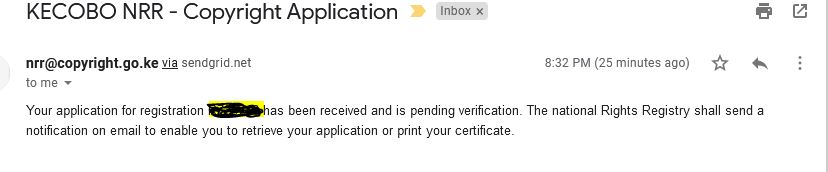
    10. Once the details of your work are submitted to the portal, you will receive a message on your number and in your email, as below.

    11. In my experience, you will receive the results of your application in a day, or within hours.

    12.  Your Copyright Certificate is then available on your account and you can download it or View it, as needed.

    Authors, if you’re able to do this on your own, please do it.  It is very easy and you have control on how and when you can access your copyright certificates.  If you ask someone else to do it for you, please be sure it is someone you can trust and that you’re able to access your copyright certificates at will.

    If you have more questions on what you can copyright in Kenya, please visit this KECOBO Frequently Asked Questions link and go through the different types of creative media that you can copyright.  Alternatively, you can email them or call them for help and support.

    Kenya Copyright Board – Email: nrr@copyright.go.ke

    Copyright your work today.

  • How do you find out the cost of self-publishing your book in Kenya?

    How do you find out the cost of self-publishing your book in Kenya?

    This question paralyzes the majority of writers in Kenya. It is the most asked question in my inbox. So, I am going to make a be-courageous-and-take-matters-into-your-own-hands post. Educate yourself on the words Word-count, Book size and Genre. Your manuscript is a product. Fiction or Non-fiction, it is a product. Know what your desired product looks like.

    What is the cost? How much will you need? How do I know the cost?

    In this post, we came up with a short guideline on how to decide what type of book you want to create. There are six questions you need answers to, only then can you decide the size of the book you want to produce.  

    If you’re writing fiction, know what size of work you want to create and in what genre you want to write in. That is:-

    • 1. Short Story – 0 to 7,500 words
    • 2. Novelette – 7,500 to 17,500 words
    • 3. Novella – 17,500 to 40,000 words
    • 4. Novel – 40,000 words and above.

    Where does your current work fit in the list below?

    This is a list of Genres / categories when publishing on Amazon’s KDP. Use it as a guideline. Where does your current work fit?
    • Choose a Genre: (Read this post on why you need to choose a genre) Once again, you cannot write for everyone, ‘everyone’ s’ tastes are different. Genres are as follows:
      • Children’s books
      • Romance
      • Action
      • Historical
      • Mystery
      • Thriller
      • Fantasy
      • Slice-of-life and many more etc.
    • Remember each size of story requires a different type of workload from you.  You must understand that the cost of printing a novel with 40,000 words and above is more than the cost of printing 7,500 words.

    The word count determines the amount of money you’ll spend when it comes to self publishing. It becomes very important to choose the number of words you want to produce in the type of work you want to create. 

    If you’re writing a non-fiction book, decide what size of work you want to create as well. The word count is leveled the same as the list above. Remember your chosen topic and industry. If you’ve chosen academic writing, follow the rules of that process. Do the research e.t.c. The cost of printing non-fiction is also determined by the presence of photographs and diagrams (color or black & white). The more photos and colored-diagrams, the more cost.

    Once you write your manuscript, then you can start thinking about editing and the cost of editing. Once again, editors look at the amount of words (Word Count) you need edited, and the work you have already put in to make it easier to edit.

    Scenario: if your manuscript has typos, misspelled words, grammar challenges, for fiction – a confusing story, for non-fiction – a mishmash of ideas with no real point, an editor is looking at your manuscript and seeing a huge workload. They’ll either charge you a large number or decline your work.

    If you’ve made the effort to clean up your manuscript of a lot of the troubles above, an editor will have an easier time working with you, as they’re able to understand what your work is about, and what you want to achieve. The cost might reduce from a huge shocking number to a manageable number. ^_^

    So how much do you need?

    • Editing – Depends on the word count, the work you’ve already put in to your manuscript, and the type of editor you get.  It can range from 9,000/- to 50,000/- or more. An editor may help you with formatting at an added charge.
    • Book covers – From 1,500/- to 5,000/- It depends on the illustrator or graphic designer you choose.
    • Formatting and Printing – Depends on the size of book (Book Size).  Some printers don’t do the formatting services, others do.  A book with around 30,000 words costs about 180/- per book to print, depending on the type of printer you get, and how many books you want to print.
    • Printing Cost is absolutely dependent on your desired end product.  You can get it cheap, you can get it expensive.

    Shop around and discover which printer will work for you.

    So, your cost is determined by Word Count. Word Count determines your Book Size and Your Editors’s Costs. Small word-count costs less, large word – count costs more.

    Genre is what your book is about, the category it fits in and how easy or fast your readers will find it.

  • Six Things to know when Self-publishing in Kenya

    Six Things to know when Self-publishing in Kenya

    Self-Publishing is a learning journey

    Think of it as a learning journey when you enter the publishing industry. At first, you don’t really know much, but as time goes you get to learn and know what is working and what is not.  You will need patience and the will to put in work.  Your dedication is a must.  Most important, know what you want out of it.  Here are six questions you should ask yourself at the beginning.

    1. Are you publishing fiction or non-fiction?

    Are you a creative with an abundant vault of stories, poems, musings that you feel would entertain, or bring joy and inspiration to people. Fiction is art, it is very creative and comes in a myriad of forms. Best of all, there is no restriction to it. Fiction books give you more freedom to be creative.

    Are you writing non-fiction? Non-fiction books are fact-based. They are also industry-based, or educative. People read them to learn. You need to be very conversant on the topic you choose for your non-fiction book. What non-fiction topic are you passionate about? Decide – Fiction or Non-fiction.

     2. In what Fiction Genre? In what Non-Fiction Industry? 

    Now that you’ve decided what type of book you want to write, let’s break it down further. In this post, I’ll assume you’re after writing commercial/popular Fiction books as opposed to literary works or literary merit work (which is also a choice by the way). Fiction is categorized into Genres that are recognized easily by readers. For example, mystery, thrillers, romance, children’s books, e.t.c. Educate yourself on the different types of fiction people read. Then, choose a genre for your fiction work.

    For Non-fiction, decide what industry you want to write for. Are you a baker with expertise? Are you a chef with awesome cooking skills you want to share or teach? Are you a teacher who has discovered a new way to teach kids without having them memorize boring texts? What kind of content do you want to provide in your non-fiction book? At what level are you in the industry, that is, beginner/intermediate/expert? Decide –> Genre or Industry

    3. Who is your target audience? Who is your core audience?

    Now that you’ve chosen the type of book and in what genre or industry, choosing a target audience or a core audience comes next. I will tell you right now, you cannot write for everyone. Everyone is different. We all have different tastes when it comes to our fiction reads. I might enjoy Game of Thrones, someone else might find it unbearable. GOT is categorized as fantasy, on account of the dragons….lolz. Their target audience is Adults who love Fantasy. Be very niche based with your fiction, it will help you grow an audience. Are you writing for kids, young adults, adults, women, young women, young men, high school kids, the older generation, younger generation? Who are you writing for?

    In Non-Fiction, who is your core audience? Beginners, experts, novices, hobby people, intermediate, startups, people seeking inspiration? If you’re writing an autobiography, biography, life story, a literary work, what point are you trying to put across and to whom? Know it. Decide –> Who is your audience?

    4. Who is already in the game?

    Whatever your idea, fiction or non-fiction, you’d best believe that someone has already written it. You need to know it, read that content, and find inspiration from it. Your main goal is to find out what other authors, in the fiction genre or in the non-fiction industry you chose, are doing. Learn from their work, their experiences, and transform your work into something close, good, or even greater. Decide –>Who do you want to be like when your writing career grows up?

      5. What are the authors in the game before me doing to get an audience?

    Popular authors have a following, or die-hard fans that will read their work no matter what they publish. e.g. I will read anything Nora Roberts produces. Why, because I read to be entertained and know her books won’t let me down. She’s made a brand of her work. Now, your turn to make your brand. P/S – Your work at the starting point is triple, you need to convince an audience to read your work. Then, you must assure your growing audience that you’ll consistently deliver great work to entertain. Learn from the greats in your chosen Genre, or Industry. Decide–>What kind of audience do you want? e.g. Nora’s rabid fan(Elly) who will buy my work no matter what. how do i get her loyalty?

    6. Will it work for me? How can I work out my own plan?

    Now, it is very common for authors/writers to copy or emulate authors they idolize or admire. There is nothing wrong with that, unless you’re downright plagiarizing published work, which is absolutely wrong. (don’t plagiarize) However, you need a starting point, your chosen idol is a great start.

    Use it to grow your work, your voice, your style. Once you’re clear on what type of content you want to create, what it looks like at its absolute best, then find a way to make it your own. Audiences gravitate to authenticity. Decision –> Be real, don’t cheat, and map out your goals for your work. Most of all, be passionate, and that should get you passionate fans too.

    Once you understand the answers to these six questions, then you’ll have a plan to run with as you start your self-publishing journey.